
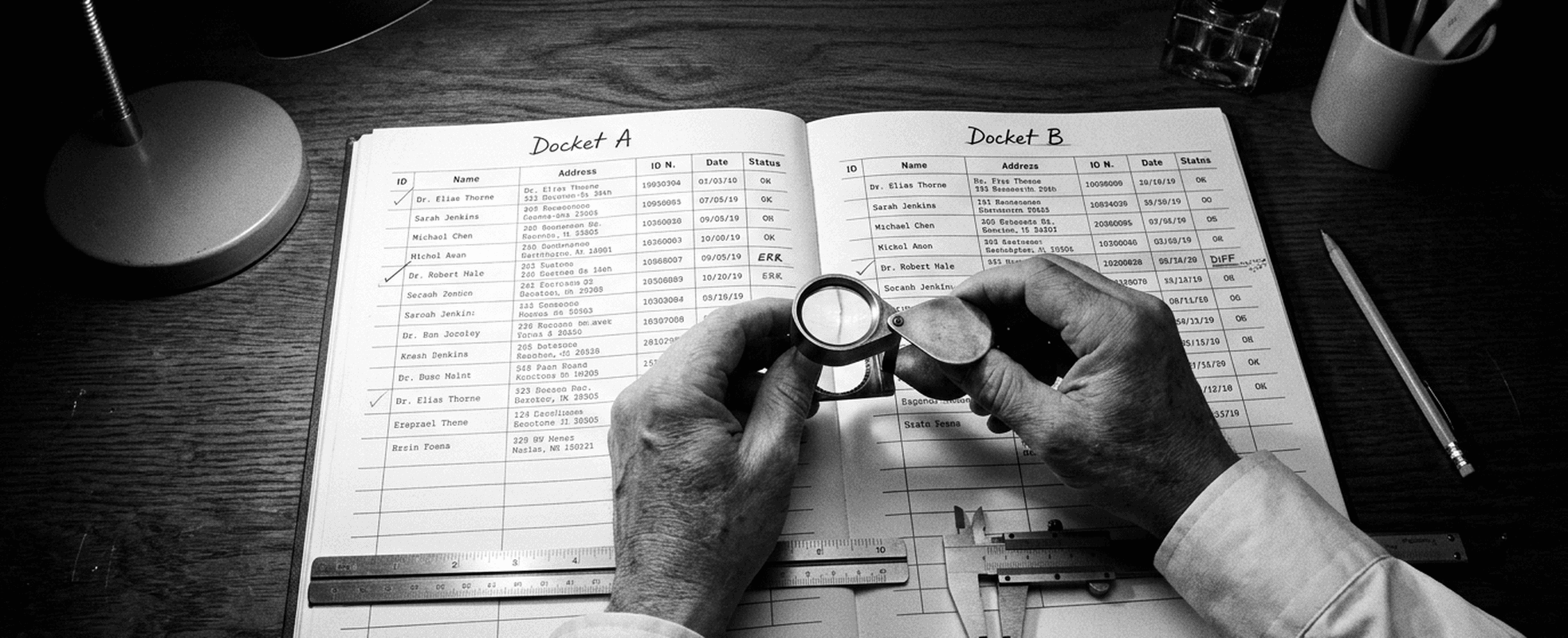
What should count as a change?
Two source responses can contain the same addresses or taxonomy codes in a different order. Comparing their raw JSON text would treat that presentation difference as an update.
Our weekly change report compares field values. The aim is to make each event interpretable, while preserving differences that carry meaning.
Compare values, then compare sets
Text is normalized for Unicode composition, surrounding whitespace and repeated whitespace. Address fields and taxonomy entries are then converted into a consistent representation, deduplicated and sorted before comparison.
Object keys also receive a stable order. This matters because the database can store JSON keys in a different order from the original response. The same values should not become an event simply because of storage representation.
For example, a synthetic taxonomy list [A, B] and [B, A] represents the same set. Changing the primary designation on A is a different value and remains eligible to produce an event.
Normalization has a boundary
This method does not decide that two different address spellings refer to the same building. It does not merge people, perform fuzzy identity matching or infer professional qualifications.
Missing, malformed and failed responses are handled as monitoring states. A lookup with no result does not by itself prove deactivation. Explicit source status and a successful field comparison are different forms of evidence.
Keep the result open to review
The feed retains previous and current values so a reviewer can inspect the exact difference. The source link and detection time supply context for the next decision.
This is a description of the current comparison rules, not a measured claim about accuracy or the percentage of noise removed.